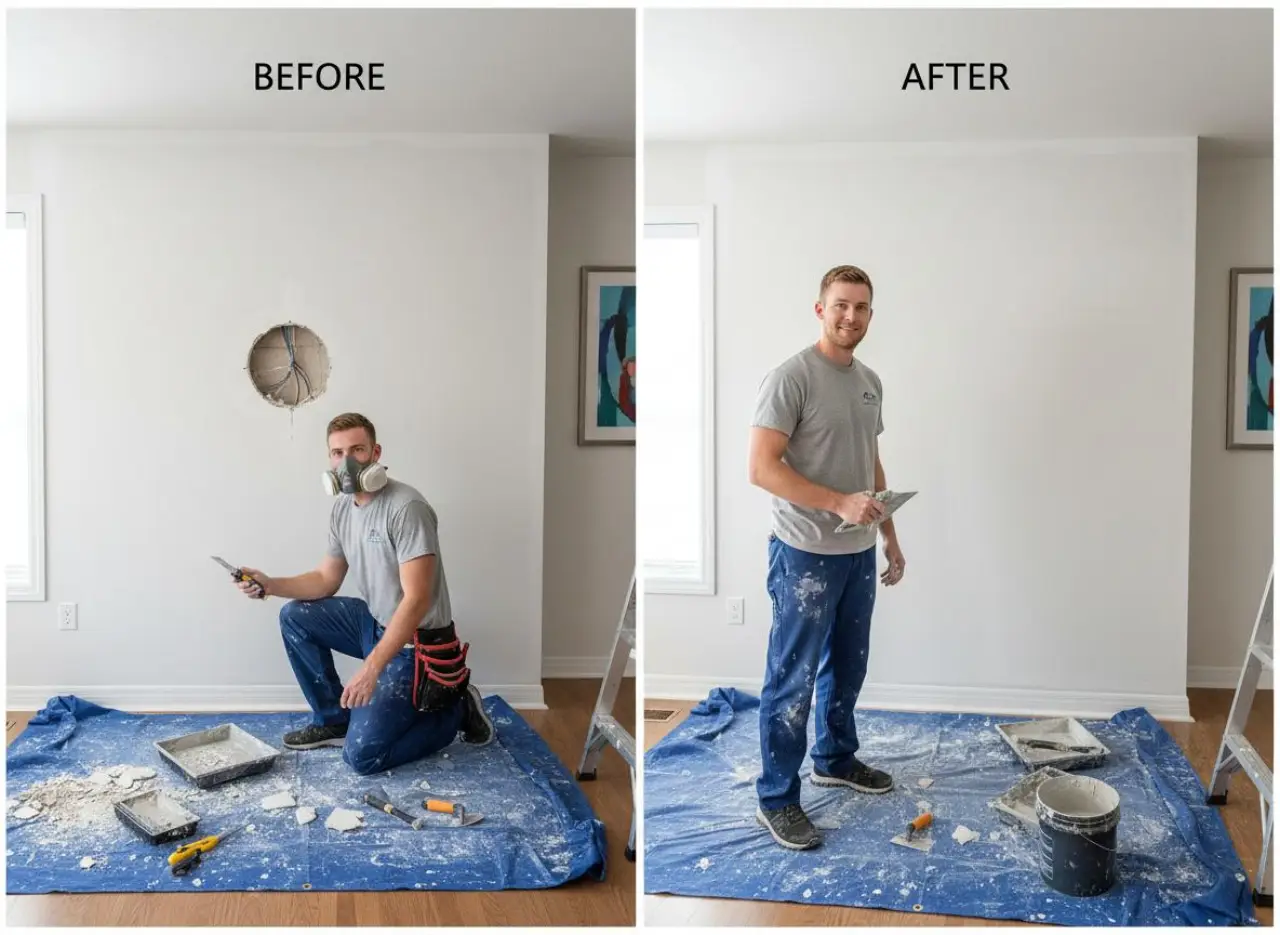
Skim coating in Calgary is how you get a smooth, paintable wall without tearing out the old one. A skim coat is a thin layer of joint compound spread over an existing surface, then sanded flat. It covers orange peel and knockdown texture, torn drywall paper where wallpaper came off, paint that has failed in sheets, and old plaster that has been patched too many times. Calgary Drywall Doctor skims walls and ceilings across Calgary, in homes from the 1912 plaster-and-lath in Inglewood to the orange-peel walls in a 2015 build in Cranston. We have done this since 2004 and it is some of the most satisfying work we do, because the before and after is so clear.
Skim coating is also the technique behind a Level 5 finish. The difference is the starting surface. Level 5 is a skim over new, freshly finished board. Skim coating as a service is a skim over something older, which means more prep and more judgement about how many coats it will take. This page covers when it is the right fix, how we do it, and what drives the cost. It is part of our drywall finishing service. Call 587-417-5252 for a free written quote.
When You Need Skim Coating
- Textured walls you want smooth. Orange peel and knockdown on walls are common in Calgary homes from the 1990s on. Smooth walls are the current preference. A skim coat over the texture is far less work than re-boarding.
- Wallpaper removal damage. Pulling wallpaper, or the paper backing that was glued straight to the drywall, often tears the drywall's own paper face. The wall looks like torn cardboard. It has to be sealed and skimmed before paint, or the torn paper bubbles under the paint.
- Peeling or alligatored paint. Many layers of old paint, or paint over a surface that was never primed, lifts in sheets or cracks in a pattern. Scraping it leaves an uneven surface that needs a skim.
- Old plaster walls. Inner-city homes in Inglewood, Bowness, Killarney, Montgomery, and Altadore have plaster that is sound but rough, with decades of patches. A skim coat flattens the whole wall. If the plaster is loose or cracking, see plaster repair first.
- Walls full of patches. A wall with 20 anchor holes, a few bad patches, and a repair from a Poly-B repipe. Spot-patching every one leaves a wall that looks like a map. A skim coat makes it one surface.
- Builder-grade finishes under new lighting. A Level 3 or 4 wall that shows joints after pot lights went in. A skim coat brings it to Level 5. See Level 5 drywall finish.
- Ceilings after texture removal. Scraped popcorn or knockdown leaves a rough, uneven surface. The skim coat is what makes it a flat ceiling. See popcorn ceiling removal.
Our Skim Coating Process
- Assess the surface. We look at what is on the wall, how well it is bonded, and how uneven it is. We press and scrape a small spot to see if the paint or paper is sound. This decides prep and how many coats.
- Written, itemized quote. The scope says full-surface or spot skim, lists each room, and lists prep, priming, and dust control separately.
- Protect the room. Floors covered, furniture wrapped or out, zip walls at the door, HVAC returns taped off.
- Prep. This is where skim coating differs from new-board finishing. Loose paint gets scraped. Torn paper gets sealed with a primer-sealer so it does not bubble. Glossy paint gets scuffed and a bonding primer. Textured walls get the high points knocked down with a wide blade. Plaster gets loose spots repaired.
- Fill the low spots. Deep dents, gouges, and anchor holes get a filler coat first, so the skim coat is not doing the work of a patch.
- First skim coat. Compound is rolled on with a thick-nap roller or applied with a wide knife or trowel, then tightened off so only a thin, even layer remains. On textured walls this first coat fills the texture valleys.
- Dry, then second coat. Applied across the direction of the first to catch what it missed. Most skim coats need two coats. Heavy knockdown or rough plaster can take three.
- Sand with HEPA dust control. Fine-grit sanding to a smooth, even surface.
- Raking light inspection. A work light held flat to the wall shows any trowel marks, ridges, or texture that telegraphed through. We touch up and sand again.
- Prime. A drywall primer-sealer over the whole skimmed surface. Skimmed compound drinks paint, so this step is not optional.
- Walk-through. With you, under the room's own light.
Full-Surface Skim Versus Spot Skim
Full-surface skim
The whole wall, corner to corner, gets coated. This is the right call for textured walls, plaster, walls with many patches, and anything going to Level 5. It produces one uniform surface with nothing to compare against, which is why it looks so good under paint. It is more time and material than a spot skim, but it is the only way to get a textured wall truly smooth.
Spot skim
A limited area is skimmed and feathered into the surrounding wall. This works on smooth walls with a damaged section, such as a patch of torn paper behind a removed mirror or a corner where paint failed. It does not work on textured walls, because the smooth spot will show against the texture around it. The edges of a spot skim have to be feathered wide, often two feet past the damage, and primed with the rest of the wall or they will flash.
Skim coating over different surfaces
- Over orange peel. Two coats usually. The texture is fine and fills quickly.
- Over knockdown. Knock the high points first, then two or three coats. Heavy knockdown needs the most.
- Over torn paper. Seal first with a primer-sealer made for the job. Compound applied straight to torn paper makes it bubble and lift. Then two coats.
- Over painted walls. Scuff and bonding primer first if the paint is glossy. Flat paint in good condition can be skimmed after cleaning.
- Over plaster. Repair any loose or hollow spots, then skim with a setting-type compound on the first coat for strength, finishing with regular compound.
- Over new board. That is a Level 5 finish, and the Level 4 has to be done properly underneath. See Level 5 drywall finish.
If the walls are textured and you want to keep the texture but repair a section, that is texture matching, not skim coating. If the board itself is damaged, soft, or holed, start with drywall repair.
Skim Coating Cost in Calgary
- Full-surface or spot. Full-surface is more area and more coats.
- What is being skimmed. Orange peel is fast. Heavy knockdown and rough plaster need more coats. Torn paper needs sealing first.
- Prep. Scraping failed paint, removing wallpaper residue, and priming glossy surfaces all add time before any compound goes on.
- Area and ceiling height. Walls and ceilings are priced by area. Ceilings and tall walls take longer.
- Number of coats. Two is typical. Three on heavy texture or rough plaster.
- Occupied home. Full dust control with plastic and HEPA sanding.
- Painting. Priming is included. Finish painting is a separate line if you want us to do it.
Every quote is written and itemized after we have seen and tested the surface.
Why Choose Calgary Drywall Doctor
Skim coating done badly shows trowel marks under the first coat of paint and bubbles where torn paper was not sealed. Done right, it makes a 1950s plaster wall or a 2005 orange-peel wall look like it was boarded yesterday. We have skimmed walls and ceilings across Calgary since 2004 and we prep every surface for what it is, not for what is easiest.
Calgary Drywall Doctor is licensed, WCB-covered, and insured, with 500+ projects completed. Every job gets a written, itemized scope before work starts and a written workmanship warranty when it is done. We inspect every skimmed surface under raking light and prime it before we leave. We keep the sanding dust inside the plastic with zip walls and HEPA vacuums.
Call 587-417-5252 or email info@calgarydrywalldoctor.com for a free written quote. Skim coating is part of our drywall finishing service across Calgary, Airdrie, Cochrane, Chestermere, and Okotoks.
Skim coating is one of our drywall finishing services in Calgary.