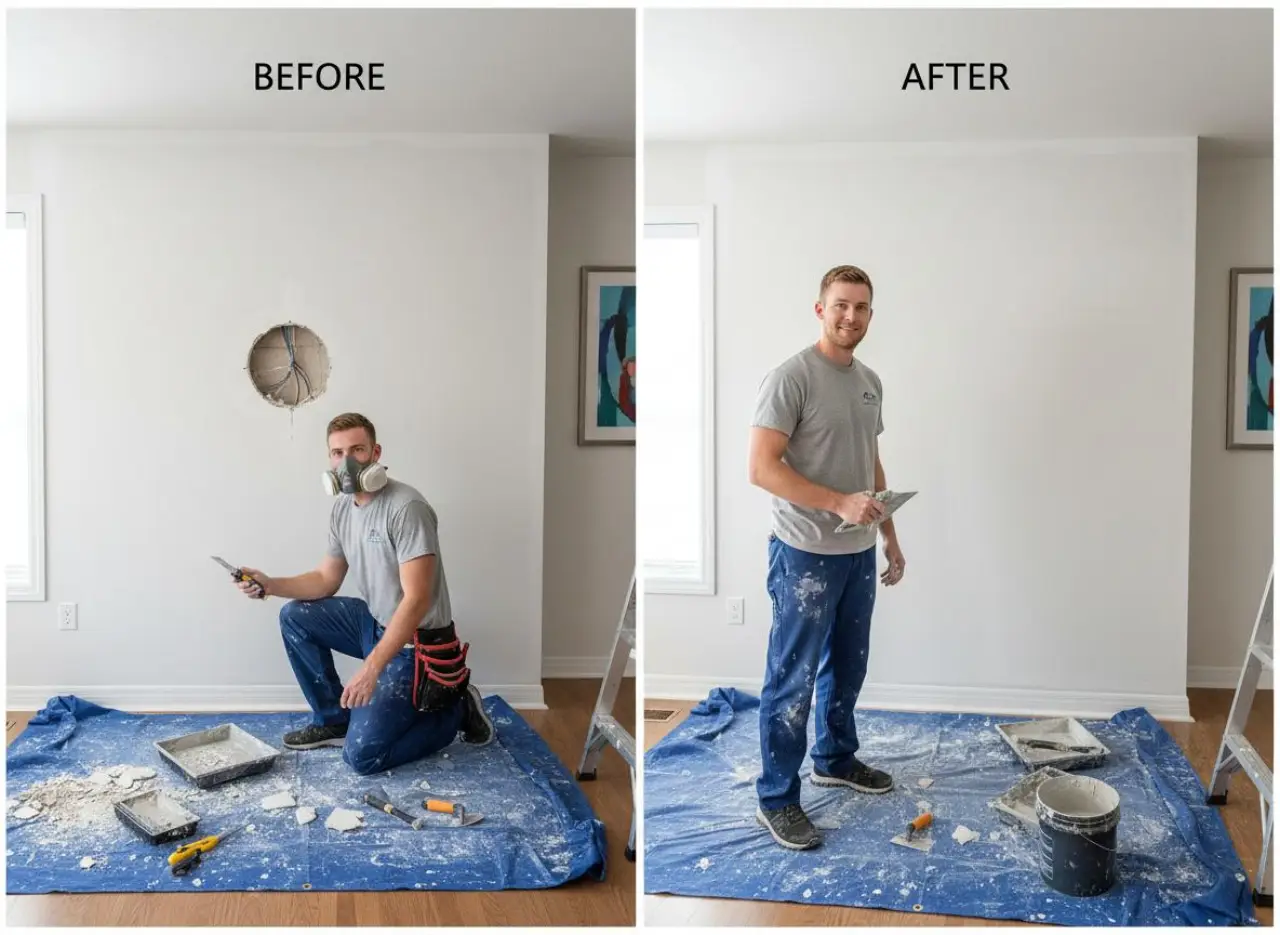
Poly-B drywall repair in Calgary is the second half of a repipe. The first half belongs to your plumber: cutting out the grey polybutylene supply lines that went into Calgary homes from roughly 1978 to 1995 and replacing them with PEX or copper. To do that, the plumbing crew opens the walls and ceilings at every fixture, every manifold and every run they cannot fish. A typical repipe leaves somewhere between fifteen and forty access holes across the house, from fist-sized to two feet square. Calgary Drywall Doctor's job is to make every one of them disappear.
We have been closing up repipes since 2004, and we have a process for it. We coordinate timing with the plumber so we arrive the day after the pressure test, not a week later. We frame backing in every hole, set new board, tape, mud, match the texture, and prime. The homeowner gets walls and ceilings ready for paint, with no bumps, no flat spots and no tell-tale rectangles under the light.
We do not do the plumbing. That is a licensed plumber's work. We open and close the walls. This page is a child of our main drywall repair service.
When You Need Poly-B Drywall Repair
You need this service if a Poly-B repipe is booked, under way or just finished in your home.
Your home was built between about 1978 and 1995. That covers a large share of Calgary: Whitehorn, Temple, Marlborough and Falconridge in the NE; Ranchlands, Edgemont, Dalhousie and Beddington Heights in the NW; Oakridge, Shawnessy and the older parts of Evergreen in the SW; Douglasdale and the earliest streets of McKenzie Towne in the SE. Airdrie, Cochrane and Okotoks have the same era of housing. If your supply lines are grey plastic with crimp fittings, that is Poly-B.
Your plumber has given you a repipe quote. Ask them how many access holes they expect and where. Most will walk you through it. That list is what we quote from, and it is worth getting us in before the plumber starts so the two scopes line up.
The repipe is done and the walls are open. This is the most common call. The plumbing is pressure-tested and signed off, and the homeowner is looking at a hallway full of rectangles. We can usually be on site within a few days.
If the plumber is also replacing a water heater or moving fixtures, there may be larger openings and some new framing. We handle that in the same visit.
Our Poly-B Drywall Repair Process
- Coordinate with the plumber. We ask for the plumber's hole plan or walk the house with them before they start. We confirm the day their pressure test and inspection will be done, and we book our first day right after. Open walls in a lived-in house are a nuisance, so we keep the gap short.
- Walk and count. On day one we walk every room, mark each opening, and note the surface: flat wall, knockdown wall, orange peel, stipple ceiling, or smooth ceiling. We check that the plumber's new lines have nail plates where they cross studs, so our screws cannot hit a pipe.
- Protect the house. Plastic on floors and furniture in every room with a hole, zip walls where we sand, and a HEPA vacuum on the sander. A repipe touches most of the house, so dust control matters more here than on a single patch.
- Square and back every hole. Plumbers cut fast, not square. We square each opening with a saw so the patch fits tight, then screw backing (strapping or blocking) inside the wall on each side so the patch has solid support. For ceiling holes the backing runs joist to joist.
- Set the patches. New 1/2-inch board, or 5/8-inch where the original is 5/8-inch, cut to each opening, screwed to the backing, edges recessed. Where a plumber has opened a fire-rated wall or ceiling, such as a garage-side wall, we use Type X and fire tape it.
- Tape and mud. Paper tape on every edge, bedded in setting compound. Then two or three coats of finishing mud, feathered wide. On ceilings and knockdown walls we feather wider still, because texture hides less than people think.
- Sand under raking light. Every patch is sanded and checked with a light held flat to the surface. We are looking for the edge of the patch. If we can see it, we add a coat.
- Match the texture. Test patches first on a scrap or an out-of-the-way spot, adjusting mix and spray until it matches. Then the real thing, blended past the edge of the patch so there is no hard line. See our texture matching page for the detail on knockdown, orange peel and stipple.
- Prime. Every patch primed, ready for paint. If you want us to paint the affected walls to the corners, we add that to the scope.
What a Repipe Does to Your Drywall
It helps to know what to expect before the plumber starts.
Where the holes go. Behind every sink, toilet and tub, where the supply lines come out of the wall. In the ceiling below upstairs bathrooms, where lines run through the floor joists. Along the main runs in the basement ceiling. Near the water heater and the main shut-off. At outside hose bibs. In a two-storey home with two and a half bathrooms, that is often twenty-five to thirty-five openings.
Surfaces involved. In a Calgary home from this era, expect knockdown or orange peel on the walls, stipple or popcorn on at least some ceilings, and smooth or lightly textured ceilings in the newer part of the range. Each needs its own texture match.
A note on asbestos. Textured ceilings applied before about 1990 may contain asbestos. If the plumber has to open a stipple or popcorn ceiling from that era, it should be lab-tested first. If it tests positive, a licensed abatement contractor handles the removal before the plumber cuts and before we patch. Ask your plumber whether they tested. We will ask too.
A note on tile. Access holes through tiled walls usually need a tile setter after us, or an access panel.
Three facts worth knowing: Poly-B was installed in Canadian homes from about 1978 to 1995. A repipe commonly leaves fifteen to forty drywall access holes. Those holes need backing and taping, not just filler, or the patches will crack.
Poly-B Drywall Repair Cost in Calgary
We quote the whole house in writing, itemized by opening, after seeing the plumber's plan or the open walls. No prices here because every repipe is different. The factors:
- Number of openings. The main driver. More fixtures and more floors means more holes.
- Size of openings. Larger holes need more backing and more board. Ceiling holes take longer than wall holes.
- Textures. Smooth walls are quickest. Knockdown and orange peel need matching. Stipple and popcorn ceilings take the longest, and may need testing first.
- Fire-rated locations. Garage-side walls and some ceilings need Type X and fire taping.
- Tile and cabinets. Openings behind cabinets, vanities or tile need extra handling or a separate trade.
- Priming and painting. Priming is included. Painting walls to the corners is optional and quoted separately.
Getting us involved before the repipe starts usually keeps the cost down, because we can ask the plumber to keep holes square and in reachable spots.
Why Choose Calgary Drywall Doctor
Repipes are a big part of our repair work. We have been doing them across Calgary since 2004, and we know what a plumber's cut looks like and how to make it vanish. More than 500 projects completed, licensed, WCB-covered and insured, and a written workmanship warranty on every patch.
We work around your plumber's schedule rather than making them work around ours. We back every hole so patches do not crack. We match texture with test patches, not guesswork. And we check every patch under raking light before we prime, so what you see after paint is a wall, not a repair.
Dust control is standard: plastic, zip walls and HEPA vacuuming, in every room we touch. You live in the house while we work, and we treat it that way.
Other repairs on the same visit are easy to add. Our drywall repair page covers nail pops and cracks, and if the plumber had to open a basement ceiling, our basement drywall crew can re-board a larger area. For textured ceilings that were opened up, see ceiling repair.
Poly-B access hole repair is part of our drywall repair service in Calgary, alongside water damage, plaster, texture matching, cracks and nail pops.