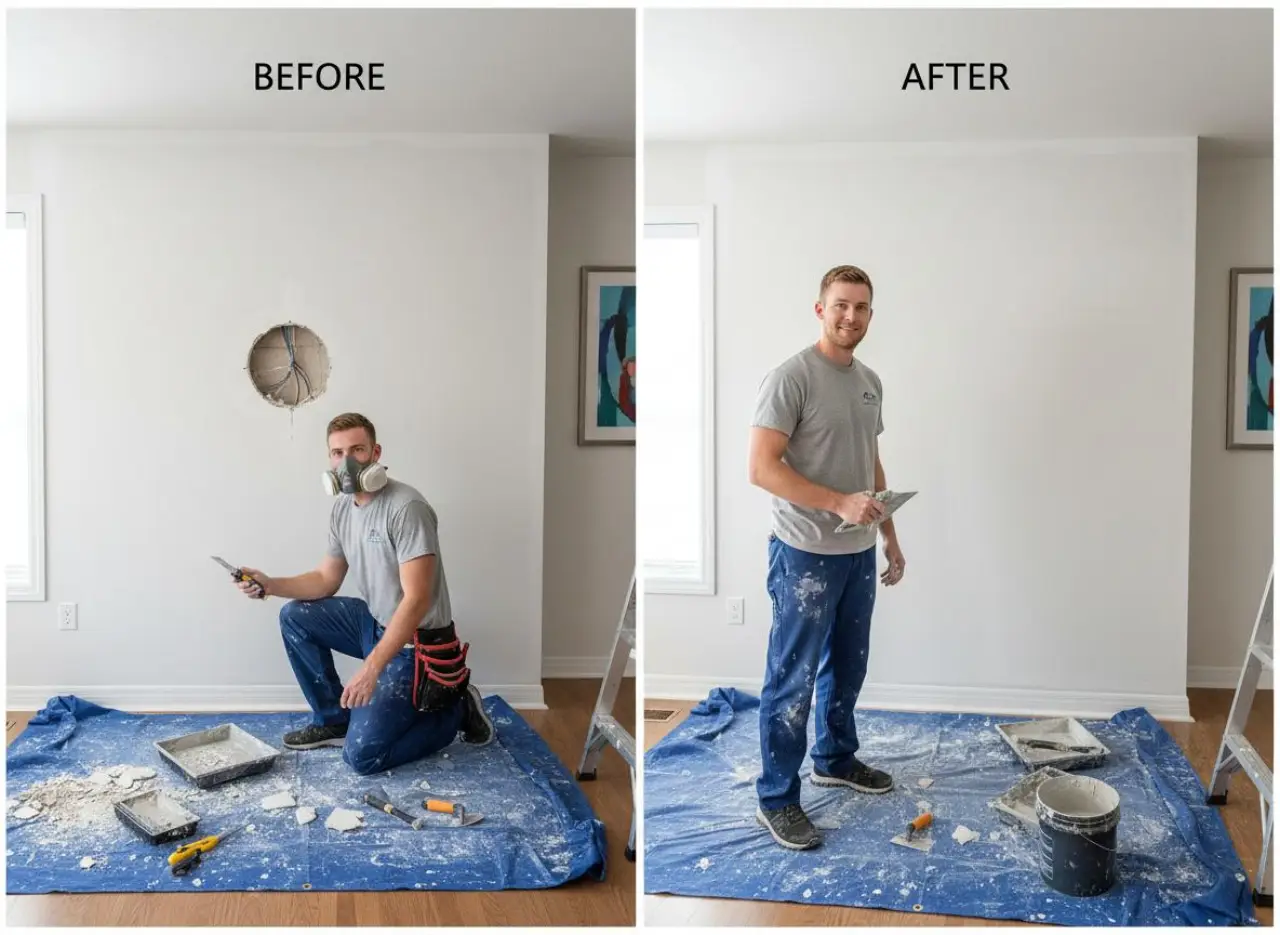
Water damage drywall repair in Calgary starts with a moisture meter, not a trowel. Drywall that has been wet looks fine once the surface dries, but the gypsum core can stay damp for weeks, the paper face loses its bond, and mould can grow on the back side where nobody sees it. Calgary Drywall Doctor has repaired water-damaged walls and ceilings across the city since 2004, and the rule on every one of them is the same: measure first, cut out what is not sound, and only then patch.
Most of the water damage we see here comes from a short list of causes. Hail and wind damage to roofs and skylights, which shows up as ceiling stains days or weeks after a summer storm. Ice damming at the eaves in late winter. Bathroom leaks from a toilet seal, tub overflow or shower pan. Burst or pinhole-leaking pipes, including failing Poly-B in homes from the late 1970s to mid 1990s. Window well and foundation leaks in basements. Each leaves a different pattern, and we read the pattern to find the source.
This is a child service of our drywall repair page, which covers cracks, nail pops and holes.
When You Need Water Damage Drywall Repair
Call us if you see any of these.
A yellow or brown ring on the ceiling. The classic roof leak or upstairs bathroom stain. The ring is the mineral and tannin line left as water dried. One ring that has not grown may be from a leak that was already fixed. A ring with a darker wet centre means it is still active.
Sagging or bowed ceiling board. Drywall that has absorbed a lot of water loses its strength and droops between the joists. This is a safety issue. Wet ceiling board is heavy and can come down. Do not poke it. Call us and keep people out from under it.
Soft or crumbling wall board. Press the wall near the bottom. If it gives, flakes or feels spongy, the core is gone. Common after a basement flood, a dishwasher leak, or a slow leak behind a vanity.
After an insurance event. If a restoration company has already removed wet board and dried the space, you may have open walls and ceilings waiting for drywall. We do the re-board, tape, texture and prime so the room is ready for paint.
One thing we ask before booking: has the source of the water been fixed? If the roof is still leaking or the pipe is still dripping, we will meter and advise, but we hold the repair until the leak is stopped. Patching over an active leak wastes your money.
Our Water Damage Drywall Repair Process
- Moisture readings. We use a pin or pinless moisture meter on the stained area and in a grid around it, on the drywall and, where we can reach it, on the framing behind. Dry drywall reads in the low teens or under on most meters. Anything well above that, or anything that reads wet several feet from the visible stain, tells us the damage is bigger than it looks. We write the readings down and tell you what they mean.
- Find and confirm the source. We look at where the water came from and trace it. A ceiling stain under a bathroom is usually plumbing. One near an exterior wall after a storm is usually roof or flashing. If the source is not obvious, we say so and recommend the right trade. We do not do plumbing or roofing; we open and close the walls.
- Drying. If readings are high but the board is otherwise sound, we leave it open to dry and re-meter before closing.
- Cut out what cannot be saved. Soft, sagging, delaminated or stained-through board comes out, cut back to solid material and squared to the nearest framing. Wet insulation behind it comes out too.
- Check for mould. Any growth on the back of the board, the framing or the insulation gets flagged. Small areas on framing can be cleaned and treated. Larger areas need a remediation contractor before we close the wall. We will not board over visible mould.
- Replace the board. New drywall is set on backing, screwed and recessed. In basements, bathrooms and anywhere water may return, we use mould-resistant board. In bathrooms it is moisture-resistant green or purple board, with cement board behind tile.
- Seal the stain. Where a stain is on sound board and only the surface is affected, we seal it with a stain-blocking primer. Regular primer or paint will not hold back a water stain. It bleeds through within weeks.
- Tape, mud, texture, prime. Standard finish process: paper tape, three coats, sanded under raking light, texture matched with test patches on knockdown and stipple ceilings, then primed.
- Written scope for your insurer. If this is an insurance claim, we provide a written scope you can send to your insurer. It lists what was removed, what was replaced and the finish work done.
Board Types and Why They Matter After Water
The board we put back is a chance to make the wall more forgiving next time.
Standard 1/2-inch drywall is a gypsum core faced with paper. The paper feeds mould once it gets wet and stays damp. It is fine where the leak was a one-time event.
Moisture-resistant board (the green or purple sheets) has a treated core and a water-repellent face. It is the right choice for bathroom walls outside the tub and shower, laundry rooms and kitchens. It is not waterproof, and it should not be used as a tile backer in a shower.
Mould-resistant board has a fibreglass face or a treated paper face that resists mould growth. We use it on basement walls, around water heaters and anywhere a leak has already happened once.
Cement board goes behind tile in showers and tub surrounds. It does not swell or break down with water.
5/8-inch Type X is used where a fire separation is required, such as a garage ceiling or a legal suite. Water-damaged Type X has to be replaced with the same rated board and fire-taped, not patched with standard 1/2-inch.
A fact worth knowing: drywall that has been soaked and has sagged, swelled or lost its paper bond cannot be dried back to full strength. It has to be replaced. Drywall that got damp on the surface but reads dry through the core and has no sag can usually be sealed and refinished.
Water Damage Drywall Repair Cost in Calgary
Every water damage job gets a free, written, itemized quote after we meter and look at the source. No prices on this page because the spread is wide. What moves the number:
- How far the water travelled. A one-foot ceiling stain on sound board is a seal-and-refinish. A ceiling that reads wet across three joist bays is a cut-out and re-board.
- Ceiling versus wall. Ceiling work is slower, needs more setup, and often involves texture.
- Insulation and framing. Wet insulation has to come out and be replaced. Framing that has been wet long enough to stain or soften needs drying time or a carpenter.
- Mould. Small spots on framing can be treated by us. Larger growth needs a remediation contractor first.
- Board type. Mould-resistant, moisture-resistant and Type X cost more than standard board.
- Texture and finish level. Matching a knockdown or stipple ceiling, or bringing a wall to Level 5 under raking light, adds time.
Why Choose Calgary Drywall Doctor
We have repaired water-damaged drywall across Calgary since 2004, with more than 500 projects behind us. Licensed, WCB-covered and insured, with a written workmanship warranty on every repair.
What matters on a water job is discipline. We meter before we patch. We do not close walls over damp framing or visible mould. We use stain-blocking primer so the ring does not come back. And we check the finished repair under raking light so a ceiling patch does not show as a flat spot the first time the sun comes through the window.
We work with your plumber, roofer or restoration company and coordinate timing so the wall is only open as long as it needs to be. Dust control with plastic, zip walls and HEPA vacuuming is standard on every repair.
Need other repairs done at the same time? Our drywall repair page covers cracks, nail pops and holes, and our ceiling repair crew handles sagging and textured ceilings. Basement floods that need full re-boarding fall under basement drywall.
Water damage repair is part of our drywall repair service in Calgary, which also covers cracks, nail pops, holes, Poly-B access holes, plaster and texture matching.