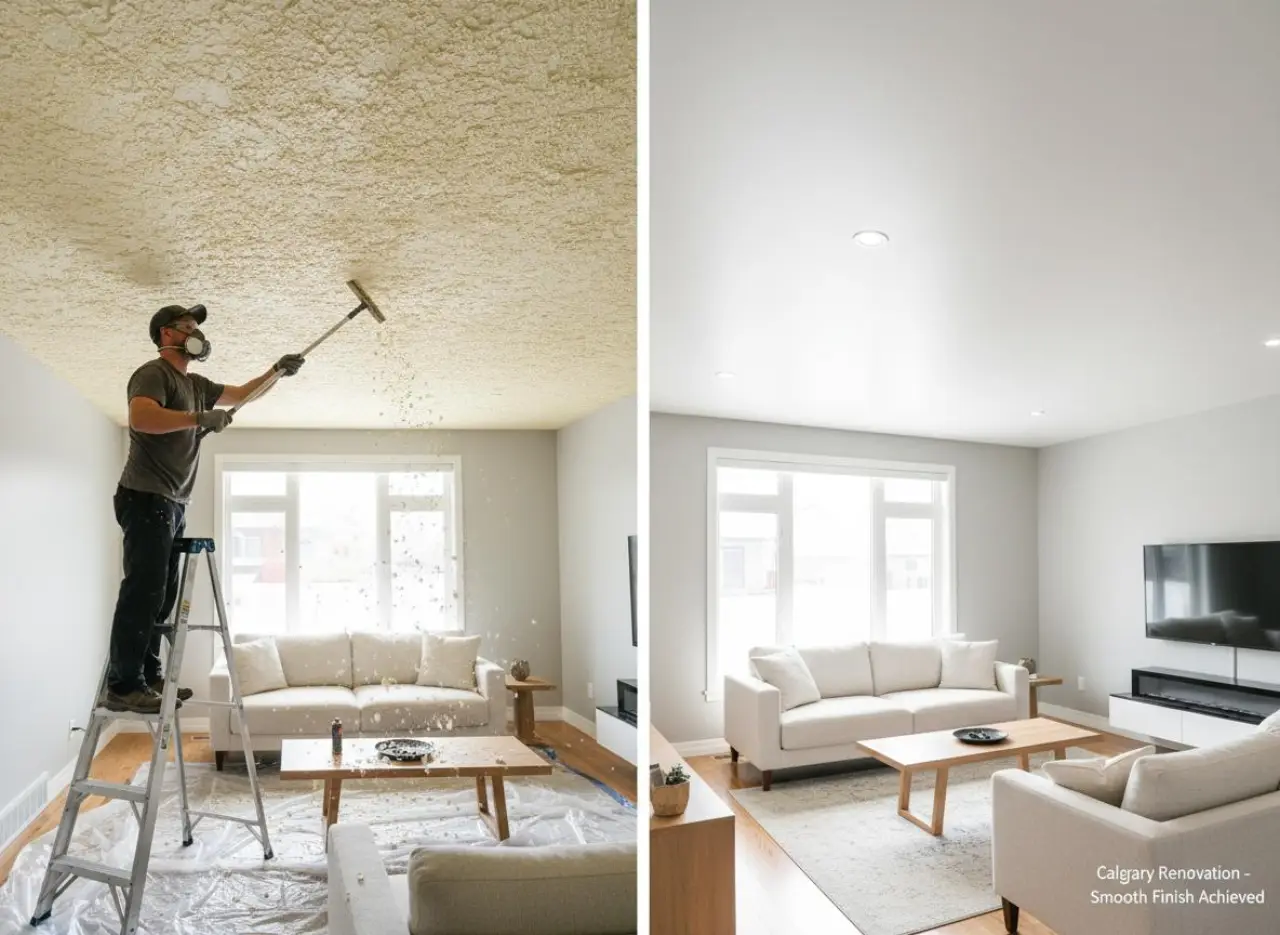
Ceiling repair in Calgary is a different job from wall repair. Everything is overhead, the board is heavier, and most of the problems we see come from the house moving, water getting in, or a ceiling that was built a little too light for its framing. Calgary Drywall Doctor has repaired ceilings across the city since 2004. We fix water stains and soft spots, sagging board, cracked joints, truss uplift cracks, and the holes left behind after pot-light and plumbing work. We also remove old textures and apply new ones so the repair disappears.
Every ceiling job starts the same way: we look at why it failed before we touch the board. A stain from a one-time roof leak gets patched. A stain that keeps coming back means the leak is not fixed yet, and we will tell you that. If the ceiling is in a basement, see our basement drywall page as well. For wall damage, our drywall repair page covers that side of the job. Call 587-417-5252 for a free written quote.
Signs You Need Ceiling Repair
Ceilings fail slowly, then all at once. These are the problems we get called for most often in Calgary homes.
- Water stains. Brown or yellow rings mean water sat on the back of the board. Common after hail damage, ice damming, a failed tub seal upstairs, or a slow drain leak. The board may look fine but feel soft when you press it.
- Sagging between joists. A ceiling that looks wavy or pillowed between the framing is usually 1/2" regular board hung on trusses spaced 24 inches on centre. Over time the board droops under its own weight, and heavy texture makes it worse. The fix is usually new 5/8" board or 1/2" ceiling board, not more screws.
- Cracks where the ceiling meets the wall. If a crack opens along the top of an interior wall every winter and closes in spring, that is truss uplift. The roof trusses bow upward as the top chord stays cold and dry while the bottom chord warms. The drywall gets pulled apart at the corner.
- Cracked or peeling tape joints. Straight cracks that follow a seam are usually tape that lost its bond, often from dry winter air, a thin first coat, or movement.
- Nail pops and screw pops. Small round bumps or craters. Framing lumber dries and shrinks, and the fastener head pushes through the mud.
- Holes from pot-light retrofits. Old fixtures removed, a hole cut on the wrong side of a joist, or a can light pulled out and left as a six-inch opening.
- Damaged bulkheads and dropped ceilings. Bumped corners, cracked corner bead, or bulkheads that were never finished properly in the first place.
- Old texture you want gone. Popcorn or heavy knockdown that is stained, flaking, or just dated.
A ceiling that is dripping, bulging with water, or hanging down in a section should be dealt with right away. Turn off power to any lights in that area and call us.
What Affects the Cost of Ceiling Repair in Calgary
We do not quote ceilings by the square foot over the phone, because the price depends on what is behind the board. These are the factors that move the number up or down.
- Size of the damaged area. A single stain patch is a different job from re-boarding a whole room. Once a repair covers more than about a third of the ceiling, replacing the full ceiling is often the cleaner result.
- Ceiling height. Standard eight-foot ceilings are done from benches. Vaulted ceilings, stairwells, and two-storey foyers need scaffolding or a lift and take longer.
- Texture. A flat ceiling is faster to blend. Knockdown, orange peel, and stipple all need test patches to match. Popcorn repairs often mean removing more than the damaged spot so the new texture does not show a border.
- Asbestos testing. Any textured ceiling applied before about 1990 should be lab-tested before we sand, scrape, or cut it. If the test comes back positive, a licensed abatement contractor removes the material first. That is a separate step with a separate cost that is not ours.
- What caused it. Water-damaged board can hide wet insulation, mould, or a leak that is still live. We will not close up a ceiling over a wet cavity.
- Board thickness and framing. Sag repairs on 24-inch framing need heavier board, and sometimes strapping, which means more material and more labour.
- Insulation and vapour barrier. Top-floor ceilings sit under the attic. The poly and insulation have to go back properly, and that is part of the job.
Every quote is written and itemized, so you can see each of these as a line, not a lump sum.
Our Ceiling Repair Options
Ceiling work splits into a few distinct services. Most jobs use one or two of these together.
Patch and tape repairs. Water stains, pot-light holes, cracked joints, nail pops, and corner bead. This is the bread and butter of ceiling repair, and most of it is done in one or two visits.
Sag repair and re-boarding. When the board itself has failed, we take down the old ceiling, check the framing, add strapping if needed, and hang new 5/8" board or 1/2" ceiling board rated for 24-inch spacing.
Popcorn Ceiling Removal. Choose this when you want the stipple gone for good. We test pre-1990 texture first, then scrape or skim the ceiling and finish it flat. This is the most common ceiling upgrade in 1960s to 1980s Calgary homes.
Knockdown Ceiling Removal. Heavier textures take more work to remove than popcorn. We scrape, skim, or overlay the ceiling with new 1/2" board depending on how thick the texture is and what shape the board underneath is in.
Ceiling Texture Application. Choose this when a repair needs to blend into an existing textured ceiling, or when you want a new knockdown, orange peel, or stipple finish on a flat ceiling.
Acoustical Ceiling Installation. Suspended T-bar grids and tiles for basements, home offices, and utility areas where you need access to plumbing and ducts above.
If the damage is tied to a leak, our water damage drywall repair page explains how we check moisture before closing anything up. For ceilings opened up during a repipe, see Poly-B drywall repair. When the repair is done and you want the whole ceiling to look new, our drywall finishing page covers skim coats and Level 5 finishes.
Our Ceiling Repair Process, Step by Step
This is how a typical ceiling repair runs from the first call to the walk-through.
- Site visit and moisture check. We look at the damage, press the board, and put a moisture meter on any stain. If the reading is high, we find out why before we quote the repair.
- Written, itemized quote. You get a scope in writing that lists the repair, texture matching, priming, and any board replacement as separate lines. No work starts until you approve it.
- Protection and dust control. Floors get drop sheets, furniture gets plastic, and doorways get zip walls on larger jobs. We run a HEPA vacuum on the sanders. Ceiling dust falls straight down onto everything, so this step matters more than it does on walls.
- Cut back to sound board. Stained or soft board comes out to the nearest framing member. We check the insulation and vapour barrier and replace anything wet.
- Board and fasten. New board is screwed to framing, with backing added where the old cut did not land on a joist. For sag repairs we use board rated for the framing spacing.
- Tape and three coats. Paper or mesh tape, then a fill coat, a second coat, and a finish coat. Each coat dries fully before the next. We do not rush this, because rushing is why the last repair cracked.
- Sand and inspect under raking light. We hold a work light flat against the ceiling to show every ridge and dip, then fix them. Ceilings catch more light than walls, so this is where a repair either disappears or shows.
- Texture match, if needed. We spray or hand-apply texture on a test board first, compare it to the existing ceiling, and adjust before touching yours.
- Prime. Every repair is primed so paint takes evenly. Bare mud and old paint absorb paint at different rates and will flash if you skip this.
- Clean up and walk-through. We vacuum, pull the plastic, and go over the repair with you under normal room light.
Ceiling Repair for Calgary Homes
Calgary ceilings fail for reasons that are specific to our climate and our housing stock.
Truss uplift. This is the number one winter ceiling complaint we get. It shows up in homes with engineered roof trusses, which means most houses built from the 1970s on in communities like Ranchlands, Shawnessy, and Coventry Hills. The crack opens along the ceiling-to-wall corner on interior walls, usually near the middle of the house. The proper fix is not just more mud. We float the corner so the ceiling board can move without tearing the joint, or we install a trim detail that hides the movement.
Dry winter air and Chinooks. Indoor humidity in a Calgary house in January can drop very low. Then a Chinook rolls through and it swings. Wood framing shrinks and swells, and tape joints and nail heads take the strain.
Hail and roof leaks. Summer hail hits the whole city, and a roof that was fine in June can have a slow leak by August. Stains show on top-floor ceilings first. We patch after the roofer has confirmed the repair is done.
Pot-light retrofits. Homes from the 1990s and 2000s in Tuscany, McKenzie Towne, and Douglasdale often get them added later. Electricians cut the holes; we patch the ones that did not work out and blend the texture.
Popcorn and stipple. Mostly 1960s to 1980s homes in Brentwood, Dalhousie, Huntington Hills, Acadia, Willow Park, Marlborough, and Whitehorn. Many of these ceilings have never been touched. We test first, then remove.
Basement ceilings. Older basements in Lakeview, Oakridge, and Silver Springs often got a drywall ceiling screwed straight to the joists with no access to shutoffs or cleanouts. We repair those, or convert them to a T-bar grid where access matters.
We cover all four quadrants of Calgary, plus Airdrie, Cochrane, Chestermere, and Okotoks.
What to Expect When You Call
Call or email and tell us what you see. Photos help, especially one wide shot and one close-up of the stain or crack. We can give a rough sense of the job from photos, but we will not give a firm number until someone has pressed the board and checked for moisture.
We book a site visit, usually within a few days. On the visit we measure, check the attic or the room above if we can, and ask what caused the damage. You get a written, itemized quote. Most jobs are booked within 2 to 3 days of approval. Small patches are usually two visits: one to board and tape, one to finish, sand, texture, and prime. Larger ceilings take longer because every coat has to dry. We tell you the schedule before we start, and we tell you if it changes.
Why Choose Calgary Drywall Doctor for Ceiling Repair
We have been fixing Calgary ceilings since 2004, and we have taken down a lot of other people's repairs. The ones that failed almost always skipped a step: no moisture check, no raking-light inspection, one coat instead of three, or texture sprayed without a test patch.
Calgary Drywall Doctor is licensed, WCB-covered, and insured. Every job gets a written, itemized quote before work starts and a written workmanship warranty when it is done. We have completed 500+ projects across Calgary and the surrounding towns. We check moisture before closing up any ceiling repair, and we inspect every finish under raking light before we call it done. We keep dust under control with plastic, zip walls, and HEPA vacuums, because a ceiling job in a lived-in home should not mean a week of cleaning afterward.
Call 587-417-5252 or email info@calgarydrywalldoctor.com for a free written quote on your ceiling.
Calgary Drywall Doctor is a Calgary drywall contractor serving all four quadrants of the city plus Airdrie, Cochrane, Chestermere, and Okotoks.