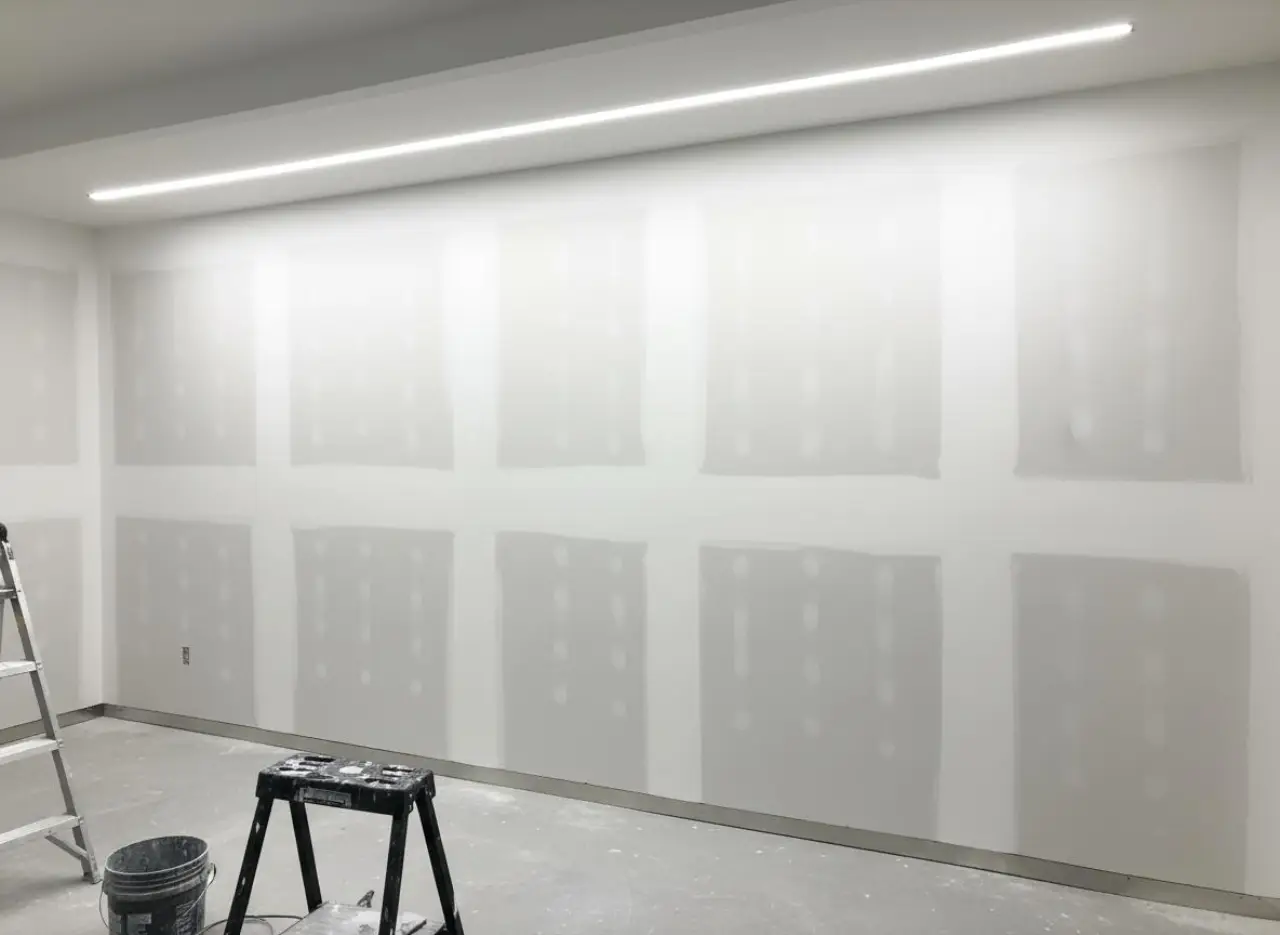
Soundproofing drywall in Calgary is about building a wall or ceiling that stops sound instead of passing it along. A standard interior wall, with one layer of 1/2" board on each side of wood studs and nothing in the cavity, lets normal conversation through. A soundproofed wall uses mass, separation and damping to stop it. Calgary Drywall Doctor has built sound-rated walls and ceilings in Calgary homes since 2004 as part of our drywall installation work, mostly for bedrooms, home theatres, home offices and the ceilings of basement suites.
We install resilient channel, double-layer board, damping compound and acoustic sealant across Calgary, Airdrie, Cochrane, Chestermere and Okotoks. Call 587-417-5252 for a free, written, itemized quote.
When You Need Soundproofing Drywall
The rooms that come up most often:
- A basement secondary suite, where the ceiling between the suite and the main floor needs to limit footsteps and voices in both directions. City of Calgary suite rules and the Alberta Building Code set minimum sound performance for suite separations.
- A home theatre or media room where you want to turn it up without the rest of the house hearing it.
- A bedroom beside a living room, a bathroom, or a teenager's room.
- A home office on a shared wall with the kids' playroom.
- A duplex or semi-detached party wall, or an infill where the neighbour is close. Infill building in communities like Killarney, Altadore and Inglewood has made party walls a frequent request.
- A laundry or mechanical room next to a bedroom.
- A music room or a workshop with power tools.
Soundproofing works best when the walls are open. If you are already doing a basement development or a renovation, this is the time to add it. It can be done on an existing wall by adding a second layer over the old board, but you lose the chance to insulate the cavity and decouple the framing.
Our Soundproofing Drywall Process
- Talk about the noise. Footsteps from above, a subwoofer, voices and TV all need different fixes. We ask what you are trying to stop and in which direction before we suggest an assembly.
- Written scope. The quote lists the assembly for each wall or ceiling: insulation, channel, number of layers, damping compound and sealant.
- Insulate the cavity. Fibreglass or mineral wool batts in the stud or joist bay absorb sound inside the wall. This is cheap and helps every assembly.
- Install resilient channel. Metal channel runs across the studs or joists, and the board hangs on the channel, not the framing. That gap breaks the direct path for vibration. Screws must not touch the framing through the channel, or the channel is short-circuited.
- Hang the first layer. 5/8" board on the channel, with a small gap left at the perimeter.
- Damping compound and second layer. A Green Glue-type damping compound is spread on the back of the second layer of 5/8" board, which is hung with joints offset from the first layer. The compound turns vibration between the layers into a small amount of heat instead of sound.
- Seal the perimeter. Acoustic sealant fills the gap at floor, ceiling and corners. Electrical boxes get putty pads. Sound finds any air gap, so this step matters as much as the board.
- Tape, three coats, sand, inspect. The finished wall is taped and finished like any other and checked under raking light.
STC Basics: Mass, Decoupling, Absorption and Damping
STC in plain terms. Sound Transmission Class is a single number for how much airborne sound a wall or ceiling blocks. Higher is better. Roughly: a basic wood-stud wall with one layer of 1/2" board each side and no insulation is in the low to mid 30s, where normal speech is easy to hear. Add insulation and you gain a few points. Add resilient channel and a second layer of 5/8" board with damping compound and the same wall can reach the mid to high 50s, where loud speech is hard to make out. These are rough figures for lab-tested assemblies; real walls with doors, outlets and ducts come in lower.
Four ways to stop sound. Mass: heavier board, more layers. Decoupling: resilient channel or staggered studs so the two sides are not rigidly connected. Absorption: insulation in the cavity. Damping: compound between layers to dissipate vibration. The best assemblies use all four; the cheap ones use only mass.
Footsteps are different. Impact noise through a floor, like footsteps above a basement suite, is harder to fix than voices. Resilient channel and double layers on the ceiling below help, but carpet and underlay above help as much. We will say so rather than promise a silent ceiling.
Doors. A hollow-core door in a soundproofed wall gives most of the gain back. A solid-core door with seals around the frame keeps it, and a home theatre often gets two doors with a small lobby between.
Flanking. Sound goes around a good wall through ducts, back-to-back outlets, the floor and the ceiling. We offset boxes, seal penetrations and run the assembly past the room where we can.
Where it fits with fire separation. Suite separations usually need both fire and sound performance. A double layer of 5/8" Type X on resilient channel often does both jobs; see fire-rated drywall and legal suite drywall.
Two facts to keep: a single screw through resilient channel into the stud defeats the channel, and sealing the perimeter with acoustic sealant matters as much as the number of layers.
Soundproofing Drywall Cost in Calgary
Soundproofing is quoted by the assembly on each surface. The lines on your itemized quote:
- Area of the walls or ceilings being treated.
- Assembly chosen: insulation only, channel plus single layer, or channel plus double layer with damping compound.
- Damping compound and acoustic sealant, priced by the sheet and the perimeter.
- Number of electrical boxes, ducts and penetrations to seal or putty.
- Whether the wall is open or we are adding to an existing finished wall.
- Finishing: Level 4 for paint, or higher.
- Whether it is part of a basement or suite job already in progress.
The biggest cost jump is from a single layer to a double layer with damping compound. It is also the biggest jump in performance, so it is usually worth it on the one wall or ceiling that matters most.
Why Choose Calgary Drywall Doctor
We build sound walls the way the assemblies were tested, screw by screw and bead of sealant by bead, because a soundproofed wall with one shortcut in it is just a heavy wall. We tell you honestly what an assembly will and will not stop. We are licensed, WCB-covered and insured, quotes are free, written and itemized, and the work carries a written workmanship warranty.
To make a room quieter, call 587-417-5252. For our full range of boarding and finishing, see drywall installation; for suspended T-bar ceilings in basements and offices, see acoustical ceiling installation.
Soundproofing drywall is part of our full drywall installation service in Calgary.