Calgary’s Drywall Specialists — 587-417-5252 — Written Quotes — No Obligation
Residential Drywall — Calgary

Garage Drywall
Built for Alberta Winters

Calgary garages are treated as afterthoughts by most contractors. An attached garage has code requirements (Type X fire separation on shared walls), climate requirements (vapour barrier and board type depend on whether it’s heated), and durability demands from -30°C to +5°C swings every winter. Getting any of these wrong means failed inspections, callbacks, or drywall that delaminates by year three.

Call 587-417-5252
Type X fire separation
Heated & unheated garages
Written quote before work starts

Attached Garages Have More Requirements Than Most Contractors Know

Alberta Building Code requires a 1-hour fire separation between an attached garage and living space — 5/8” Type X drywall on the garage side of shared walls and ceiling (if living space above). Standard 1/2” board fails inspection and voids fire insurance on claims. It’s not a technicality; it’s a fundamental assembly requirement that determines how long occupants have to exit in a fire.

Heated vs. unheated garages differ significantly in what goes behind the board. A heated garage needs a vapour barrier on the warm side of insulation before boarding — without it, moisture from the conditioned space migrates into the wall cavity and condenses on cold exterior sheathing. An unheated garage has the inverse risk: condensation forms on the board surface during cold snaps. Moisture-resistant board is the correct choice here, even without a full vapour barrier system.

Our crew scopes the full assembly before quoting — board type, vapour barrier placement, fastener pattern for inspection-ready Type X, perimeter sealing, and penetration caulking on every electrical box and pipe sleeve. You receive a written quote with materials itemized before we lift a sheet.
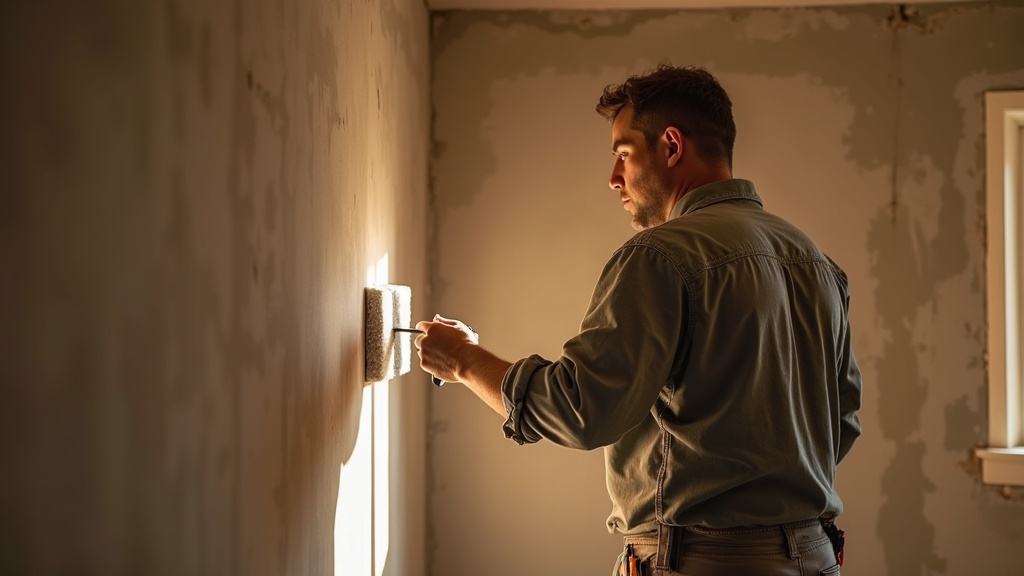
Garage drywall installation Calgary — Type X fire separation and vapour barrier

A Proper Garage Drywall Assembly — Zone by Zone

Board type isn’t a single decision across a garage — it changes by zone. Here’s what the Alberta Building Code and sound building science require for each area of a typical attached garage.

Zone Board Required Key Requirement
Garage-to-house wall (attached) 5/8” Type X 1-hour fire separation per ABC 9.10.9.1
Ceiling above garage (with living space above) 5/8” Type X Fire separation continues through ceiling
Exterior garage walls (unheated) Moisture-resistant 1/2” Condensation protection
Exterior garage walls (heated) Standard 1/2” or better Vapour barrier required on warm side
Ceiling (detached garage) Standard 1/2” No fire separation required

What Fails Inspection — and What Voids Your Insurance

The three most common garage drywall failures we see when called in to fix previous work. Each one requires stripping and redoing the assembly — there is no patch for a missed fire rating or a failed vapour barrier.

Wrong Board Type

Using standard 1/2” drywall where Type X is required is the single most common garage drywall failure we encounter. Inspectors measure board thickness at cut edges. If you’ve had prior work done and aren’t sure what’s behind the tape, we can do a moisture check and assembly review as part of the quoting process.

Skipping Penetration Sealing

Every electrical box, pipe sleeve, and HVAC duct penetrating the fire wall must be sealed with approved fire caulk. One unsealed box negates the entire assembly’s fire rating. Inspectors look specifically at penetrations because they’re the most commonly missed element — and the most important one in a real fire event.

No Vapour Barrier in Heated Garages

Moisture from the heated space migrates into the wall cavity and condenses on the cold exterior sheathing. Without a vapour barrier, this causes mould inside the wall within 2–3 winters. Calgary’s dramatic temperature swings accelerate this cycle compared to milder climates. The problem is invisible until the mould has spread significantly.

Case Study — Thorncliffe, Calgary

Attached 2-Car Garage Converted to Heated Workshop

A homeowner in Thorncliffe was finishing a large attached 2-car garage as a heated workshop. The scope revealed the shared house wall had standard 1/2” drywall from the original 1997 construction — never updated despite two prior renovation permits on the main house. The existing board didn’t meet the current code requirement for the 1-hour fire separation.

Our crew removed the old board, ran a moisture check on the framing behind it, installed a vapour barrier on all exterior walls (heated space requires it), re-boarded the fire wall with 5/8” Type X with correct fastener spacing and perimeter caulking, and used moisture-resistant board on all exterior walls. All penetrations were sealed with approved fire caulk before inspection. The project passed inspection on the first attempt.

640
Sq Ft
1
Inspection Pass
0
Callbacks

Garage Drywall Questions

Do I need a permit to drywall my attached garage?
Yes in most Alberta municipalities — attached garage work tied to fire separation or electrical is typically permit-required. The City of Calgary requires a permit when work affects a fire-rated assembly or involves new electrical rough-in. We factor permit timing into the written quote so you know what to expect before we start.
What drywall goes on the wall between my garage and my house?
5/8” Type X — required by Alberta Building Code for the 1-hour fire separation between an attached garage and any living space. Standard 1/2” board does not meet this requirement and will fail inspection. The Type X designation refers to a specific gypsum formulation with added fibres that slows fire penetration for a rated period.
Does my unheated garage need a vapour barrier?
Not always required, but moisture-resistant board is recommended — an unheated garage creates condensation risk at the wall cavity even without a formal vapour barrier requirement. In Calgary’s climate, unheated garages cycle through significant temperature ranges, and standard paper-faced drywall exposed to repeated condensation will delaminate. Moisture-resistant board is a low-cost upgrade that extends the life of the assembly substantially.
Can I use 1/2” drywall anywhere in an attached garage?
Yes — on the exterior walls not shared with living space, standard 1/2” or moisture-resistant 1/2” is acceptable. Only the fire separation walls (shared with living space or with living space directly above) require Type X. Detached garages have no fire separation requirement and can use standard board throughout, though moisture-resistant is still a good choice for exterior walls.
Can I finish a garage to Level 4?
Yes — a heated workshop or finished garage is a reasonable candidate for Level 4 finish. Level 4 is appropriate for any space that will receive flat, eggshell, or satin paint. We quote the finish level as part of the full scope. If you’re building a proper workspace with finished walls, paint-ready Level 4 adds minimal cost at the taping stage and looks significantly better over time than a basic tape-and-fill.

Ready to Get Your Garage Done Right?

Written quote with materials itemized. We confirm board type, vapour barrier, and fire separation requirements before we start.

Back to Residential Drywall