Alberta basements are unforgiving. Moisture-resistant board, correctly installed vapour barriers, and a written scope before we touch anything — that's how basement drywall gets done right in Calgary.
Standard drywall does not belong in an Alberta basement. Concrete foundation walls are constantly subject to moisture migration — especially with Calgary's dramatic seasonal temperature swings. Standard board absorbs that moisture silently, and by the time you see a problem, there's usually mold in the wall cavity and degraded framing behind it.
Our crew uses moisture-resistant board on every basement job and installs the vapour barrier correctly — on the warm side of the insulation, before any board goes up. We also run a moisture check before we start, because the most expensive basement drywall job is the one you have to do twice.
Written scope, moisture-resistant materials, correct vapour barrier placement, and a final walkthrough when you're satisfied. That's the baseline for every basement job we take on.
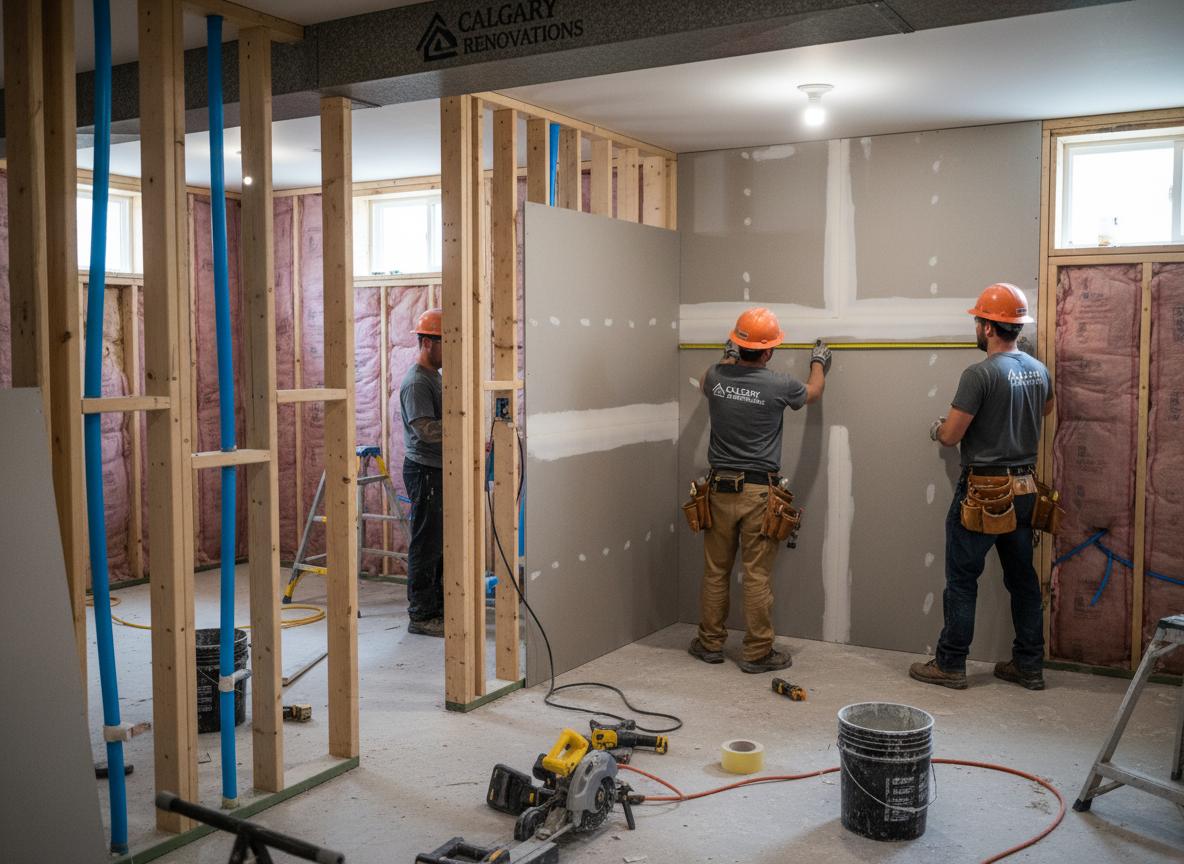
Most basement drywall failures in Calgary come down to the same few mistakes. Here's what to watch for.
Standard drywall in a basement absorbs moisture from concrete and subfloor humidity. Within a few Alberta winters, it softens, grows mold, and fails.
A vapour barrier installed on the cold side (against concrete) traps moisture inside the wall cavity instead of blocking it. We see this constantly on DIY and rushed contractor jobs.
Drywalling over an active moisture source — a slow foundation seep, condensation point, or drainage issue — just hides the problem until it's significantly worse.
Basement living spaces need at least Level 4 finish. Garages and utility rooms can be Level 3. Most contractors default to Level 3 everywhere without asking. We discuss it before the scope is written.
Why is basement drywall in Calgary different from anywhere else in Canada?
Calgary's climate is extreme in both directions — cold dry winters and warm summers create significant seasonal pressure on foundations. Concrete breathes. As temperatures drop and rise, moisture migrates through basement walls in ways that most homeowners don't see until it's already caused damage. The moisture-resistant materials and correct vapour barrier placement aren't optional in an Alberta basement — they're the baseline. A contractor who treats a Calgary basement like a main floor renovation is setting the homeowner up for a repeat job within a few years.
What's the most common basement drywall mistake our crew encounters in Calgary homes?
Vapour barrier installed on the wrong side. It happens on DIY jobs and rushed contractor jobs constantly. The vapour barrier needs to go on the warm side of the insulation — between the insulation and the drywall — so moisture from inside the heated space can't migrate into the wall cavity. When it's installed against the concrete instead, it traps moisture inside the wall. We've opened up basement walls where the framing was completely saturated and the homeowner had no idea, because the drywall surface looked fine. The problem was invisible until it wasn't.
Can you walk through a real Calgary basement drywall project that shows why the moisture check matters?
A home in Brentwood — newer build, the owners had finished the basement themselves about eight years prior. They called us because a section of wall near the window well felt soft when they pressed on it. When we opened that section, we found mold through the entire wall cavity, wet insulation, and framing that had started to show signs of rot. The window well had a slow drainage issue that had been feeding moisture into that wall for years. We spent a full day just on the moisture assessment before touching a single board. Addressed the drainage issue, treated the framing, replaced the insulation, installed moisture-resistant board with correct vapour barrier. The wall section that looked like a small repair turned into a proper remediation — but now it's done right.
What's the difference between standard drywall and moisture-resistant drywall, and when do you use each?
Standard drywall has a gypsum core with paper facing. Moisture-resistant drywall (often called green board or purple board) has a treated gypsum core and a fibreglass mat facing instead of paper — the paper facing is what mold colonizes first. In any basement application in Calgary, we use moisture-resistant board as the default. For areas directly adjacent to bathrooms or utility spaces, we step up to cement board or higher-rated products. Standard board stays on main floors and upper levels where it's appropriate. Using the right material in the right location is a basic part of the job — it shouldn't cost extra to get it right.
What does a properly done basement drywall job look like from start to finish?
It starts with a moisture check — not a quote. We probe the walls, check the floor perimeter, look at the window wells and any penetrations, and assess what the framing looks like if we have access. Only then do we write the scope. If there's a moisture issue, we address it before any board goes up — no exceptions. Vapour barrier goes in correctly. Moisture-resistant board is cut and hung. We tape, mud, and finish to the level appropriate for how the space will be used. A basement living room gets Level 4 finish at minimum. A utility room gets Level 3. The final walkthrough is yours — you tell us when it's done.
A homeowner in Brentwood noticed a soft spot on a basement wall. Two walls away from a window well with a drainage issue that had been quietly feeding moisture into the wall cavity for years.
When the wall was opened: mold through the full cavity, saturated insulation, early-stage framing degradation. The surface looked fine. The inside was not.
Full day on moisture assessment before any board was ordered. Drainage issue addressed first. Framing treated. New insulation. Moisture-resistant board throughout with correct vapour barrier. Level 4 finish on the living area, Level 3 on utility spaces.
We probe walls, check floor perimeters, inspect window wells and penetrations before we quote anything. If there's an active moisture source, we address it before any board goes up.
Every line item in writing — including the specific board type and vapour barrier spec. No verbal estimates, no material surprises on the invoice.
Vapour barrier on the warm side of the insulation, every time. This is non-negotiable for a Calgary basement.
Green board or equivalent as the baseline in all basement spaces. Higher-rated materials near bathrooms and utility areas.
Living spaces get Level 4 minimum. Utility and storage areas get Level 3. We discuss this before the scope is written — not after the mud is dry.
You walk every inch. You point. We fix. Done when you say done.
Yes. Standard drywall absorbs moisture from concrete over time, leading to mold and structural damage. We always use moisture-resistant drywall in basement applications, combined with a correctly installed vapour barrier.
A typical Calgary basement takes 5–8 working days for full drywall installation and finishing, depending on size and finish level. If moisture remediation is required, we add that time before any board goes up. We provide a written timeline with every quote.
On the warm side — between the insulation and the drywall. This prevents moisture from inside the heated space from migrating into the wall cavity. Installing it against the concrete (cold side) traps moisture inside the wall, which is one of the most common causes of basement mold in Calgary.
Typically $1.50–$3.50 per square foot depending on finish level, ceiling height, and scope. Moisture-resistant materials add a small premium. We provide free written quotes with itemized pricing — no verbal estimates, no surprises.
Yes. We match existing textures — knockdown, orange peel, smooth, or custom — so repaired or new sections blend seamlessly with the rest of the space.
Free on-site assessment. Moisture check included. Written scope before we touch anything.